Star Wars Phantom Menace Review
Sorry about the Facebook re:book, but this is hysterical. Besides, what else is there to do in a snowstorm??

Another reason to switch to trillion
Tiger on my aim. Why, oh WHY??
Paid for not showing up
 Are you kidding me?? This is a job I would like to have. No, LOVE to have! But, however, I would think once or twice or three times BEFORE ordering any kind of equipment from Avaya. But then again, how stupid was Armatys to try and withdraw money from a 401k?? As my 3rd grade teacher would say, “e- gads and little fishes.” (I would say, fuggin’ asshole.)
Anthony Armatys is facing up to six years in prison for his dumb move. But he’s not the only dummy in this story. Ammatys accepted a job in 2002 with telecom equipment maker Avaya but then changed his mind before he started. He was already in the payroll system however, and the company started depositing his six-figure salary into his checking account.
For five years, Armatys did not notify Avaya of its error, but his attempt to make an early withdrawal from his 401(k) prompted an investigation that led to his arrest In October Armatys pleaded guilty to theft and was ordered to repay the $470,995.53 in compensation he received. He faces full sentencing in January.
Lara cooks AGAIN. Veggie goat cheese omelet. Try it, you’ll like it!
Can you believe it? Hey, times will change once this CEO gets out of the house office and into the office office. But for NOW…lunch is cooking. Sometimes.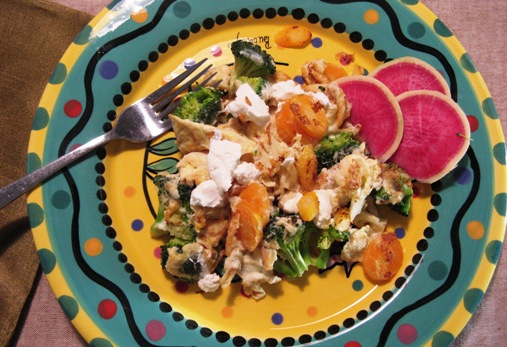

A truly Bloomingdales Christmas
So, it is my most favorite time of year to go to Bloomingdales, because it is there, without guilt, I am truly able to enjoy the most wonderful X-mas decorations in the city. And, since they also have the best Hanukah candles anywhere (beeswax and all that), I make it a tradition to go, once a year with Bella to enjoy the festivities. But, this year, since Bella had LOADS AND LOADS of homework (or she just didn’t feel this was any longer a cool think to be doing), I made my annual trek with my friend Tina.
So we get to the store and I’m totally in awe of the latest and greatest Obama decoration (I mean, what will them come up with next??)  And then there is this fantastic poodle (I almost bought for the Hanukah bush, but for $24, decided to pass)
And then there was this and this:

And I’m like, “where are the Hanukah candles, this is HOLIDAY decorations, right”. And the sales girl says, “well, there over on the other side of the escalator”. And I peer down toward the escalator, and I walk toward the escalator, and I still can’t find them (but I do get the free delicious chocolate they are handing out) and finally I come to this:
And now I feel under represented like the brethren in my building, and I’m like really? THIS is HANUKAH? And then I notice the 40% off sign, and I’m thinking, at $14 a box, a Bloomingdale’s Hanukah ain’t that bad.
7 foods experts say can kill you
OK, I’ve reprinted this from Prevention, but HELL, this is scary. It’s like, too late for me, but perhaps those of you who have never eaten tomatoes, potatos um, even nuked popcorn (well we already knew about that) and well, other foods on this list, perhaps it’s not TOO LATE!!
1. Canned Tomatoes
The expert: Fredrick vom Saal, PhD, an endocrinologist at the University of Missouri who studies bisphenol-A
The problem: The resin linings of tin cans contain bisphenol-A, a synthetic estrogen that has been linked to ailments ranging from reproductive problems to heart disease, diabetes, and obesity. Unfortunately, acidity (a prominent characteristic of tomatoes) causes BPA to leach into your food. Studies show that the BPA in most people’s body exceeds the amount that suppresses sperm production or causes chromosomal damage to the eggs of animals. “You can get 50 mcg of BPA per liter out of a tomato can, and that’s a level that is going to impact people, particularly the young,” says vom Saal. “I won’t go near canned tomatoes.”
The solution: Choose tomatoes in glass bottles (which do not need resin linings), such as the brands Bionaturae and Coluccio. You can also get several types in Tetra Pak boxes, like Trader Joe’s and Pomi.
2. Corn-Fed Beef
The expert: Joel Salatin, co-owner of Polyface Farms and author of half a dozen books on sustainable farming
The problem: Cattle evolved to eat grass, not grains. But farmers today feed their animals corn and soybeans, which fatten up the animals faster for slaughter. More money for cattle farmers (and lower prices at the grocery store) means a lot less nutrition for us. A recent comprehensive study conducted by the USDA and researchers from Clemson University found that compared with corn-fed beef, grass-fed beef is higher in beta-carotene, vitamin E, omega-3s, conjugated linoleic acid (CLA), calcium, magnesium, and potassium; lower in inflammatory omega-6s; and lower in saturated fats that have been linked to heart disease. “We need to respect the fact that cows are herbivores, and that does not mean feeding them corn and chicken manure,” says Salatin.
The solution: Buy grass-fed beef, which can be found at specialty grocers, farmers’ markets, and nationally at Whole Foods. It’s usually labeled because it demands a premium, but if you don’t see it, ask your butcher.
3. Microwave Popcorn
The expert: Olga Naidenko, PhD, a senior scientist for the Environmental Working Group,
The problem: Chemicals, including perfluorooctanoic acid (PFOA), in the lining of the bag, are part of a class of compounds that may be linked to infertility in humans, according to a recent study from UCLA. In animal testing, the chemicals cause liver, testicular, and pancreatic cancer. Studies show that microwaving causes the chemicals to vaporize—and migrate into your popcorn. “They stay in your body for years and accumulate there,” says Naidenko, which is why researchers worry that levels in humans could approach the amounts causing cancers in laboratory animals. DuPont and other manufacturers have promised to phase out PFOA by 2015 under a voluntary EPA plan, but millions of bags of popcorn will be sold between now and then.
The solution: Pop natural kernels the old-fashioned way: in a skillet. For flavorings, you can add real butter or dried seasonings, such as dillweed, vegetable flakes, or soup mix.
4. Nonorganic Potatoes
The expert: Jeffrey Moyer, chair of the National Organic Standards Board
The problem: Root vegetables absorb herbicides, pesticides, and fungicides that wind up in soil. In the case of potatoes—the nation’s most popular vegetable—they’re treated with fungicides during the growing season, then sprayed with herbicides to kill off the fibrous vines before harvesting. After they’re dug up, the potatoes are treated yet again to prevent them from sprouting. “Try this experiment: Buy a conventional potato in a store, and try to get it to sprout. It won’t,” says Moyer, who is also farm director of the Rodale Institute (also owned by Rodale Inc., the publisher of Prevention). “I’ve talked with potato growers who say point-blank they would never eat the potatoes they sell. They have separate plots where they grow potatoes for themselves without all the chemicals.”
The solution: Buy organic potatoes. Washing isn’t good enough if you’re trying to remove chemicals that have been absorbed into the flesh.
5. Farmed Salmon
The expert: David Carpenter, MD, director of the Institute for Health and the Environment at the University at Albany and publisher of a major study in the journal Science on contamination in fish.
The problem: Nature didn’t intend for salmon to be crammed into pens and fed soy, poultry litter, and hydrolyzed chicken feathers. As a result, farmed salmon is lower in vitamin D and higher in contaminants, including carcinogens, PCBs, brominated flame retardants, and pesticides such as dioxin and DDT. According to Carpenter, the most contaminated fish come from Northern Europe, which can be found on American menus. “You can only safely eat one of these salmon dinners every 5 months without increasing your risk of cancer,” says Carpenter, whose 2004 fish contamination study got broad media attention. “It’s that bad.” Preliminary science has also linked DDT to diabetes and obesity, but some nutritionists believe the benefits of omega-3s outweigh the risks. There is also concern about the high level of antibiotics and pesticides used to treat these fish. When you eat farmed salmon, you get dosed with the same drugs and chemicals.
The solution: Switch to wild-caught Alaska salmon. If the package says fresh Atlantic, it’s farmed. There are no commercial fisheries left for wild Atlantic salmon.
6. Milk Produced with Artificial Hormones
The expert: Rick North, project director of the Campaign for Safe Food at the Oregon Physicians for Social Responsibility and former CEO of the Oregon division of the American Cancer Society
The problem: Milk producers treat their dairy cattle with recombinant bovine growth hormone (rBGH or rBST, as it is also known) to boost milk production. But rBGH also increases udder infections and even pus in the milk. It also leads to higher levels of a hormone called insulin-like growth factor in milk. In people, high levels of IGF-1 may contribute to breast, prostate, and colon cancers. “When the government approved rBGH, it was thought that IGF-1 from milk would be broken down in the human digestive tract,” says North. As it turns out, the casein in milk protects most of it, according to several independent studies. “There’s not 100% proof that this is increasing cancer in humans,” admits North. “However, it’s banned in most industrialized countries.”
The solution: Check labels for rBGH-free, rBST-free, produced without artificial hormones, or organic milk. These phrases indicate rBGH-free products.
7. Conventional Apples
The expert: Mark Kastel, former executive for agribusiness and codirector of the Cornucopia Institute, a farm-policy research group that supports organic foods
The problem: If fall fruits held a “most doused in pesticides contest,” apples would win. Why? They are individually grafted (descended from a single tree) so that each variety maintains its distinctive flavor. As such, apples don’t develop resistance to pests and are sprayed frequently. The industry maintains that these residues are not harmful. But Kastel counters that it’s just common sense to minimize exposure by avoiding the most doused produce, like apples. “Farm workers have higher rates of many cancers,” he says. And increasing numbers of studies are starting to link a higher body burden of pesticides (from all sources) with Parkinson’s disease.
The solution: Buy organic apples. If you can’t afford organic, be sure to wash and peel them first.
Inspired flounder- Lara’s cooked twice this week. Low cal, low fat.
 Yes, it’s true. Twice in one week– I actually cooked dinner and Bella actually liked it. And you must, MUST get this Balsamic Vinegar Glaze. There is NOTHING like it. Trouble is, I got it at the Fancy Food show in NY and have no idea where it’s sold. But, on the other hand, the fish is still good without it… just not as special.
Ok, so here’s the recipe –shocked are we? (make sure you add garlic to butter and brown slightly. I left it out of the recipe builder and it doesn’t let you edit. Grrrr)
…and here’s the pic. OK, it’s a Google pic, so shoot me–it’s just missing the Balsamic Glaze, but added lemon zest. In the meantime, still delish. Oh yeah, I did cook veggies, just not brocoli rabe.